



It is often whispered that to find the roots of the Georgian soul, one must follow the path of the grapevine. In Georgia, the vine is no mere crop; it is a sacred bridge to the cosmos, a primal bond that connects us to the very breath of the world.
At the heart of this devotion lies the Qvevri—an ancient clay vessel, thousands of years old, buried deep within the belly of the earth. Far more than a simple container, it is the guardian of an unshakeable faith and a silent witness to a unique resilience.
Today, the world is rediscovering this ancestral fermentation technique with wonder—a true philosophy of life where every sip tells an epic tale. For the traveler, discovering Qvevri wine is a revelation: a “living” nectar, shaped by ancient minerals and a culture of hospitality elevated to the level of the sacred.
At Wonderful Georgia Travel, we invite you to lift the stone lid of these jars and taste the very essence of the Caucasus.
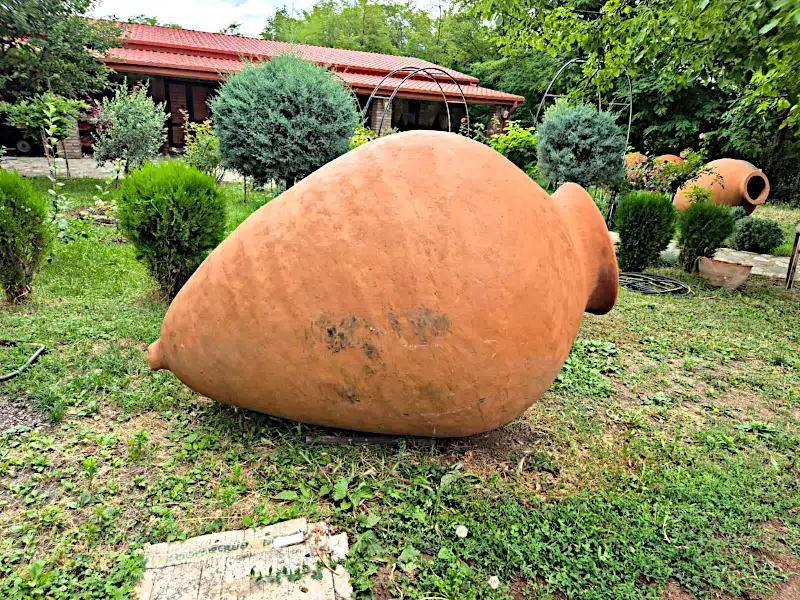
The Soul of a Nation: Why the Qvevri is the Beating Heart of Georgia
If Georgia is recognized worldwide today as the “Cradle of Wine,” it owes this title to its stubborn loyalty to the Qvevri. While the rest of the world adopted wood or stainless steel, Georgians remained bound to their earth. This singularity is not merely technical; it is historical and spiritual.
For centuries, Georgia stood at the crossroads of invasions. In the face of conquerors, the Qvevri became a tool of resistance. By burying their wine—a sacred drink linked to the blood of Christ—Georgians protected their identity and culture within the secret safety of the soil. The Qvevri was not just a cellar; it was a spiritual bunker.
Today, possessing a Qvevri in one’s garden is an affirmation of a lineage that refuses to be extinguished. This winemaking history of Georgia is an invitation to understand a people who have turned viticulture into an act of freedom.
The Epic of Clay and the Secret of Minerals
Research has confirmed that Georgia was producing wine as early as 6,000 BC. This ancient excellence is now protected by UNESCO as part of the Intangible Cultural Heritage of Humanity.
1.Craftsmanship and the Golden Ratio
Every Qvevri is hand-coiled following the principles of the Golden Ratio. This ancient mathematical precision isn’t just for beauty; it creates a natural convection current, allowing sediments to circulate and settle with a fluidity that no machine can replicate.
- What you see: Monumental workshops in Imereti or Kakheti, where massive clay jars dry under the golden Georgian sun
- Best Season: Spring and Summer, the ideal time to observe the natural sun-drying of the clay
- Local Insight: Admire the incredible patience of the artisans who build the clay walls centimeter by centimeter, entirely by hand, without a potter’s wheel
2. The Marani: A Sanctuary of the Earth
The wine rests in the Marani, a dedicated space where the Qvevris are buried deep in the ground. Here, the cleaning of the jars becomes a sonic ritual, as traditional polyphonic songs resonate against the ancient clay
- The Experience: Join a Supra (traditional banquet) in September or October during the Rtveli (the grape harvest).
- Access: Our tours take you deep into Kakheti, where we select boutique hotels featuring their own private Maranis for a truly total immersion
3. The Science of Taste
The interaction between the wine and the clay’s minerals creates a complex tannic structure and a deep amber hue (orange wine) that is naturally rich in antioxidants
Tasting Tip: Do not compare this nectar to European standards; approach it as a category entirely of its own—pure, mineral, and ancient. To begin planning your journey, visit our website.
Why Explore the Vineyards with a Local Agency?
Exploring Georgia without a local guide is like reading a magnificent book in a language you haven’t yet mastered. To truly touch the reality of the Qvevri, one must step through doors that open only through friendship and mutual respect.
- Access to Authenticity: We take you to winemakers who appear on no maps. Here, you will share the family’s own private reserve, in the very places where Georgian culture is lived every single day
- Expertise & Comfort: Our itineraries seamlessly blend the luxury of Georgia’s finest boutique hotels—such as the iconic Tsinandali Estate—with the noble, rustic charm of rural traditions
- Safety & Serenity: We handle the complex logistics of Caucasian travel. You are accompanied by French-speaking experts who master every local custom and every mountain bend
Your bespoke journey to the cradle of wine begins here.
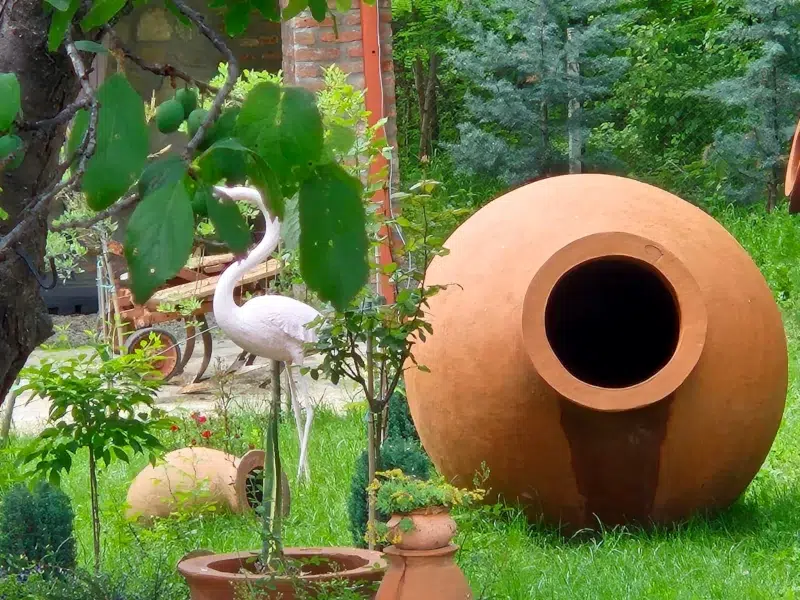
The Qvevri is waiting to share its 8,000 years of memories with you. Whether you are a seasoned oenophile or a lover of great stories, Georgia will transform the way you see the world. Are you ready for this life-changing experience? Our advisors are at your service to design a bespoke itinerary blending luxury, culture, and off-the-beaten-path discoveries
Request a personalized quote for your ‘Soul of the Caucasus’ tour. Join us for an adventure where every stop is a new friendship and every glass, a legend
FAQ: Your Questions about the Qvevri
Is Qvevri wine always an “orange wine”? Not necessarily. The Qvevri is used for both red and white grapes. For white varieties, it is the prolonged maceration with the skins (and often the stems) that creates that deep, glowing hue. Georgians prefer the term ‘Amber Wine’ over ‘Orange Wine’ to honor this ancient, natural aesthetic.
How big is a Qvevri? They range from 20 liters to a massive 8,000 liters! The largest among them are true subterranean cathedrals.
Can I bring a Qvevri back as a souvenir? A full-sized jar can weigh several tons! However, we will introduce you to skilled artisans who create beautiful miniature replicas from local clay—perfectly sized to bring a touch of Georgian soul to your home decor.