



Arriving in Telavi already gives you the sense that Georgia is shifting to a different rhythm. From the Gombori road, the light gradually opens onto Kakheti, its hills, its vineyards, and the horizon of the Alazani Valley. Telavi, the cultural capital of the region, reveals itself as a human-scale, elegant, and deeply rooted town, about 2 hours from Tbilisi depending on the route taken. Telavi’s food market is one of its finest summaries: you enter through the scents of fresh herbs, bread, cheese, grilled meat, and grapes, and you leave with a deeper understanding of Georgia itself. The town is recognized as the cultural centre of Kakheti, while the region remains the country’s main wine-producing terroir. The market therefore brings together, in a single place, the product, the gesture, the season, and hospitality.
For you, the curious traveller, Telavi Market is not simply a gourmet stop. It is a gateway into Georgian culinary culture, a deeply concrete, sensory, and local experience. It is also the perfect place to understand why Kakheti holds such a special place in the Georgian imagination: here, cuisine, wine, human exchange, and family tradition remain intimately connected.
Why Telavi Market Is Unique in Georgia
Telavi Market is not a “folkloric” market created for visitors. It is part of a genuine historical continuity. After the destruction of Gremi in the 17th century, Telavi became the new commercial centre of the region. This origin still explains today its role as an agricultural, cultural, and food hub in Kakheti.
Its uniqueness also lies in its geographical setting. Telavi is at the heart of Kakheti, a region that the National Wine Agency of Georgia presents as the country’s most important wine-producing area. This is therefore a market where wine is not just one “tasting product” among others, but a normal cultural presence, just like cheese, herbs, fruit, spices, or homemade sweets. The qvevri wine tradition, inscribed by UNESCO on the Representative List of the Intangible Cultural Heritage of Humanity, forms part of this living backdrop.
Lastly, Telavi Market remains deeply connected to everyday life. Producers from the surrounding villages bring vegetables, cereals, meat, dairy products, and homemade specialties there throughout the year. This gives it a rare authenticity for travellers seeking something more than a simple tourist showcase.
How to Visit Telavi Market, When to Go, and Above All Why You Should Taste It
Arrive Early to See the Market in Its True Rhythm
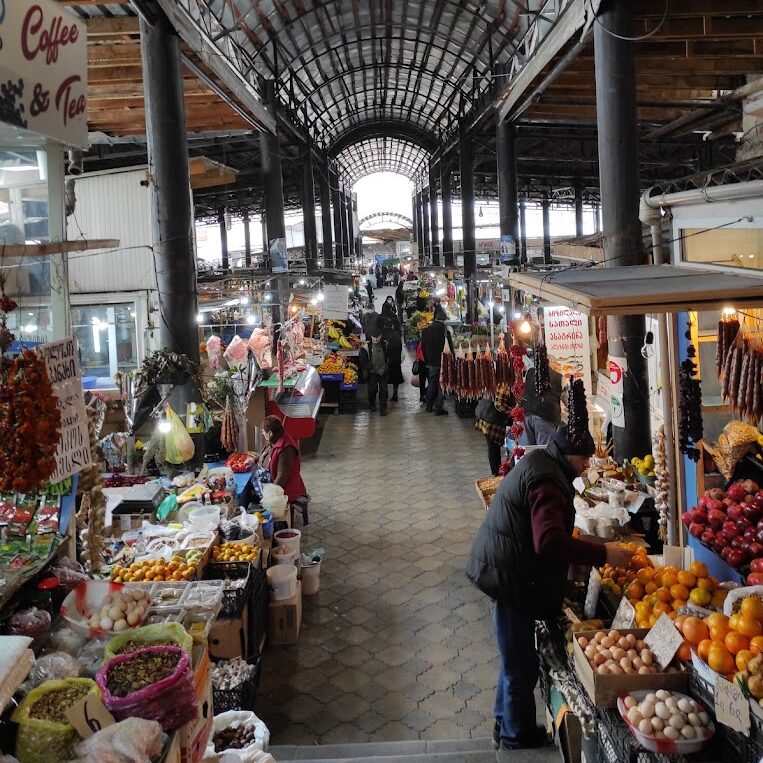
The best time to visit the market is in the morning, when activity is at its most natural and busiest. You can watch the stalls fill up, the exchanges take place, and the regulars choose their products, and you get a much better sense of the true energy of the place.
Telavi Market is particularly renowned for its dairy products. It is highly recommended to discover several Georgian cheeses there, including Akhmeta, dambalkhacho, nadughi, as well as matsoni. Do not miss the chance to taste Kakhetian Guda, a sheep’s cheese matured in a sheepskin bag (guda). It has an extremely strong smell and a sharp, almost wild flavour. It is the flagship product of the region’s shepherds. Vendors will always cut you a generous slice to taste before you buy.
It is impossible to speak about the market without mentioning Kakhetian artisanal oil, produced using traditional methods. Unlike neutral industrial oils, Kakhetian oil is a product with real character. It stands out for its rich, intense flavour of freshly roasted sunflower seeds. Unrefined, cold-pressed, and rich in vitamins, especially vitamin E, it is known for its cardiovascular benefits and its positive effect on the skin.
Finding Kakheti in Wine, Sweets, and Vineyard Products
At Telavi Market, Kakheti expresses itself naturally through qvevri wine, a tradition passed down through family and community life, chacha, churchkhela, and other grape-based products.
Churchkhela alone is worth a stop. This “traveller’s sweet,” made from nuts and concentrated grape juice, tells a story of generosity, preservation, and the deep link between food and the grape harvest.
Observing the Herbs, the Spices, and the Gestures of Everyday Life
Telavi Market is not remarkable only for its emblematic products. Its strength also lies in the details: bunches of fresh herbs, spices used in the kitchens of Kakheti and the mountains, conversations around a recipe, and products intended for very local dishes such as khashi or mtsvadi.
Including the Market in a Real Cultural Day in Telavi
Do not treat Telavi as a simple stopover; take the time to linger there, because Telavi is not limited to its market. The town is also known for King Erekle II’s palace, its old buildings, its grand avenue, and its famous 900-year-old plane tree. Visiting the market takes on its full meaning when it is included in a broader day combining heritage, gastronomy, and wine.
On paper, going to Telavi seems simple. In reality, experiencing Telavi properly is something quite different from simply “getting there.” Our local agency helps you optimise three essential elements: pace, context, and the quality of encounters. First, you save time. Travel times from Tbilisi are reasonable, but the day needs to be structured intelligently to avoid a visit that feels too rushed or poorly timed. Second, you gain a much better understanding of what you are seeing. Without explanation, the market may seem simply colourful; with the right guidance, it becomes a living interpretation of Kakheti. Finally, you benefit from more comfortable logistics: suitable transport, well-chosen breaks, translation, a selection of coherent stops, and the possibility of combining the visit with a cellar, an estate, lunch, or a heritage site.
Contact Wonderful Georgia Travel to receive:
- a personalised quotation
- a smooth and comfortable itinerary,
- or a tour proposal including Telavi and Kakheti.
Receive your free quote within 24 hours.