




In Kakheti, Zaza Kbilashvili keeps alive an ancestral craft: the making of qvevri, the clay vessel that stands as an emblem of Georgian culture. Before visitors’ eyes, he builds the qvevri by hand, tells its story, and shares, around a generous table, the living soul of Georgia.
The qvevri, a living treasure of Georgian culture
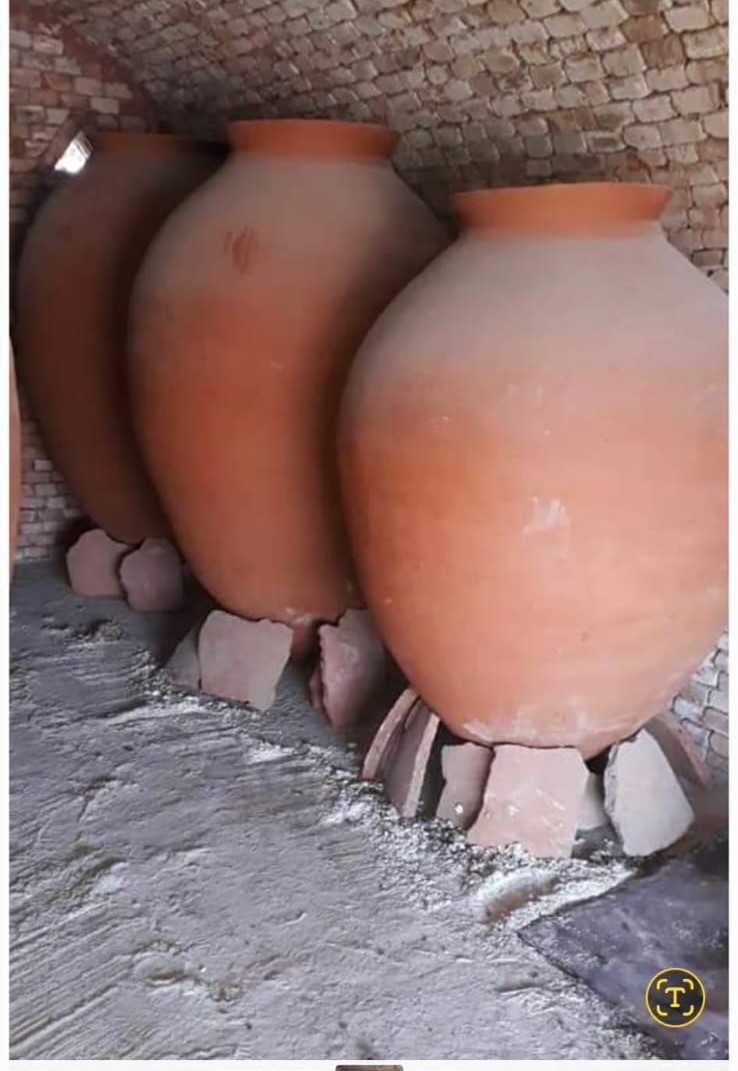
Georgia is often regarded as the cradle of wine. At the heart of this millennia-old tradition stands the qvevri, the large clay vessel buried in the ground and used for winemaking for around 8,000 years. Far more than a simple container, the qvevri embodies ancestral know-how, living memory, and an intimate bond with the land and with wine. In 2013, UNESCO inscribed the Georgian qvevri winemaking method on the Representative List of the Intangible Cultural Heritage of Humanity.
A craft learned from childhood
Even today, this heritage lives on thanks to passionate artisans who proudly pass on this know-how. Among them, Zaza Kbilashvili, a qvevri master in Kakheti, is one of those who do more than simply preserve the tradition: with simplicity and generosity, he shares it with all those who come to meet him.
“I was eight years old when I made my first small qvevri,” he recalls. “As I grew older, I began making larger and larger ones. Today, I produce large qvevri.”
In his voice, one can hear the patience of the craftsman, but also his deep attachment to a practice handed down through several generations. For making a qvevri is neither a matter of improvisation nor of speed. It is a demanding, lengthy and precise process that requires time, experience and great mastery of the material.
“Its making takes a great deal of time. First, the clay must be carefully selected — it has to be strong and suitable. Then we begin to build the qvevri. Yes, we do not simply shape it: we build it.”
This distinction is essential. A qvevri is not shaped in a single gesture. It rises slowly, centimetre by centimetre, in a delicate balance between technique, intuition and tradition.
“As for me, I build it in sections of about ten centimetres. Then I coat the inside with beeswax so that the wine can be properly preserved in it. Finally, the qvevri must either be fired in a kiln or left to dry for a long time in the sun.”
Through his words, one understands that the qvevri is not merely a handcrafted object. It is a central element of Georgian culture, a link between the earth, the vine, time and taste. Zaza speaks with emotion about the wine that is born and transformed within it.
“I am happy and proud of this unique tradition. The wine that develops, ferments and matures in the qvevri has a distinctive taste. It is very different from wine produced industrially.”
It is precisely this conviction that led him to open his world to foreign visitors. At his home, the encounter goes far beyond a simple craft demonstration. It is a true immersion in a living tradition.
“I enjoy introducing foreign tourists to our culture through the qvevri. I build it before their eyes, explain to them what it represents for us and why it is so important, and then I welcome them around a Georgian table.”
For visitors, the experience is often memorable. They discover not only a rare craft, but also a distinctly Georgian way of welcoming, passing on and sharing.
“Visitors watch the qvevri being made and listen with great interest as I speak about our traditions. I can see their amazement. And when they later sit down at the Georgian table, their sense of wonder grows even stronger.”
With Zaza Kbilashvili, discovering the qvevri naturally extends into hospitality. The artisan’s gesture then meets the art of welcoming, so deeply rooted in Georgia.
“We welcome our visitors generously: we invite them to taste our wine, we serve them delicious Kakhetian dishes and, as they themselves say, they truly enjoy this moment.”
Meeting Zaza Kbilashvili is therefore far more than simply watching a craftsman at work. It is entering a world where clay becomes memory, where wine tells the story of a civilisation, and where Georgian tradition reveals its most sincere essence: know-how, transmission and hospitality.
For the traveller, it is a rare, authentic and deeply human experience. An opportunity to witness and closely understand one of the most singular treasures of Georgian culture.